Santiago García Sáenz (1955 – 2006) nació en Buenos Aires, donde vivirá toda su vida hasta su muerte. Se formó como pintor en los talleres de los artistas David Heynemann y José Manuel Moraña durante los años setenta y tuvo un breve paso por la universidad en la que cursó la carrera de arquitectura. Realizó sus primeras muestras en las célebres galerías argentinas Van Riel (1976) y Lirolay (1977). Ingresó a trabajar a la galería de Christel Kuker1, una compañera de taller, y exhibió sus pinturas ya decididamente figurativas, insertándose en el mundo del arte local. Entrada la década del 80, asistió a Ruth Benzacar durante los primeros años de la galería que se convertiría en uno de los espacios centrales de la escena artística de Buenos Aires. Presentó allí su trabajo en dos ocasiones, todavía fuertemente marcado por la herencia de la pintura informalista de Luis Felipe Noé, pero también por corrientes contemporáneas como el trabajo de Duilio Pierri y Marcia Schvartz.
A mediados de la década del 80, comenzó a afianzar un estilo muy personal que lo despega de sus contextos de formación. Reconectó con su fe católica, y realizó sucesivos viajes por Argentina y América Latina. Llevó adelante una serie de murales en espacios públicos: Mundus Criollo (1985), en la estación Perú por encargo de Subterráneos de Buenos Aires; un extenso mural en la Praia de Geriba, Buzios, Brasil (1986); Mural del Club Social y Deportivo Mechongué (1986); y el Via Crucis en la iglesia Santa Cecilia de Castelar (1987). Esta revitalización espiritual vino acompañada de un interés cada vez más profundo en lo autóctono y las tradiciones americanistas. Dio inicio a la serie Te estoy buscando América, que desarrollará hasta 1992. La exhibió en sucesivas ocasiones en el Centro Cultural Recoleta. Luego de recorrer el noroeste argentino y Bolivia, presentó junto con su amiga, la artista Liliana Maresca (1951 – 1994, Buenos Aires), una muestra conjunta en la Galería Centoira (1990). Viajó con frecuencia a Paraguay, donde realizaba un retiro espiritual en el monasterio benedictino Tüpasy María. Exhibió Pinturas en el Museo del Barro de Asunción, Paraguay (1991) y ese mismo año participó del evento La Conquista. 500 años. 40 artistas, celebrado en el Centro Cultural Recoleta. Durante la década de los 90 sus trabajos circularon por el Museo de Arte Decorativo (1992), el Museo de Arte Hispanoamericano Isaac Fernández Blanco (1995), Museo de Bellas Artes de Salta (1995), Centro Cultural “Eugenio Flavio Virla” de Tucumán, entre otros. Sus pinturas también fueron expuestas fuera de Argentina. En 1992, participó de la VIII Bienal de Arte Iberoamericano en México y en 1996, mostró en la Casa Argentina en Roma, Italia, ocasión que aprovechó para conocer al Papa Juan Pablo II, a quien le obsequiaría la pintura “Nuestro Señor de la Paciencia”. En 1997, ganó el Primer Premio de Pintura Joven Fundación Fortabat con “El sueño de Jacob”.
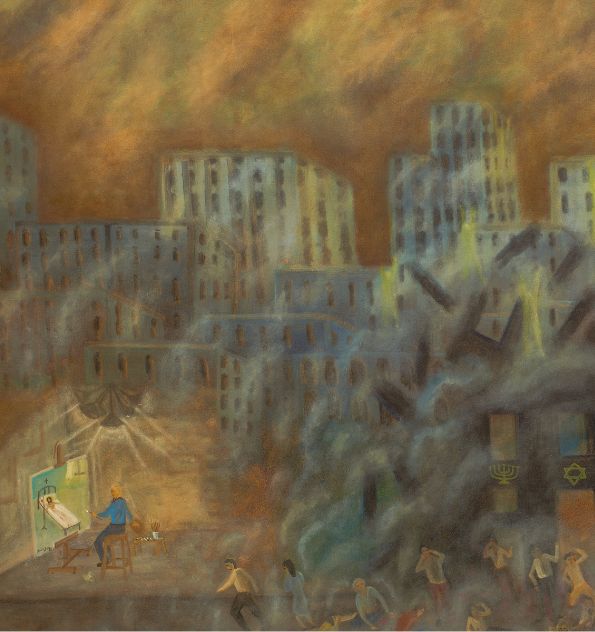
Por estos años, se vivió el peor momento de la pandemia del VIH/Sida en el campo artístico argentino. SGS fue testigo de la muerte de numerosos colegas y amigos, al mismo tiempo que vivió en silencio la enfermedad, atravesando momentos críticos. En este contexto, realizó otra de sus series más célebres, Cristo en los enfermos, que fue exhibida tanto en Buenos Aires como en Asunción. Se presentó por primera vez en el Centro Cultural Ricardo Rojas2 en 1998, bajo la dirección de Alfredo Londaibere, con una serie de mártires concebidos como parte de otra de sus series Sufriendo la intolerancia.
Al comienzo del milenio, ganó el premio del Fondo Nacional de las Artes. Continuó viajando: durante 2003 y 2004, volvió al Litoral argentino, con sus selvas y ruinas jesuíticas, que ya formaban parte de su inventario de tópicos. Exhibió en el Centro Cultural de la Universidad del Nordeste en Resistencia, Chaco y en el Museo de Bellas Artes de Corrientes. Su madurez artística lo llevó a construir un imaginario propio en el que se cruzan el barroco americano y la pintura sacra. En 2005 publicó el libro “Ángel de la guarda. 50 años de dulce compañía”, un relato autobiográfico acompañado de buena parte de su obra pictórica. La presentación se llevó adelante en el marco de una exposición individual de Auterretratos en el Museo de Arte Hispanoamericano Isaac Fernández Blanco. Ese mismo año, formó parte de una muestra colectiva en Casa Brandon, sede de la cultura LGBTTIQ+ porteña, y publicó “No matarás”, un libro con una selección de salmos realizado íntegramente en los talleres de Papelera Palermo, donde también realizó una muestra. El 9 de marzo de 2005 realizó su última exposición individual en la Galería Bacano. El 30 de marzo, falleció un día antes de cumplir 51 años.
Desde entonces, su trabajo ha sido exhibido en diversas galerías, instituciones argentinas y ferias internacionales. En 2017, su obra fue presentada en la Feria ARCO de Madrid en el marco de la exposición Saber sin mi curada por Sonia Becce y Mariano Mayer y, ese mismo año, se presentó Las horas menores, en la galería Hache de Buenos Aires, en la que por primera vez fue posible ver sus bocetos y dibujos tempranos. En 2021, la Colección de Arte Amalia Lacroze de Fortabat presentará “Quiero ser luz y quedarme”, una exposición antológica de su obra curada por Pablo León de la Barra y Santiago Villanueva, junto con un catálogo que reúne una selección de obras y ensayos.
1. Christel K. fue una galería de Buenos Aires que funcionó entre los años 1976 y 1990.
2. La galería del Centro Cultural Ricardo Rojas, dependiente de la Universidad de Buenos Aires, fue un espacio clave para la cultura y el arte de la década del 90. Por la galería, que contó con la curaduría de Gumier Maier en sus comienzos, pasaron artistas que marcarían esa generación: Marcelo Pombo, Omar Schiliro, Feliciano Centurión, Magdalena Jitrik, Fernanda Laguna, entre otres. Alfredo Londaibere sucedió a Gumier Maier, y realizó la curaduría de la galería desde 1997 a 2002.
3. La muestra contaba con obra de Santiago García Saénz, Carlos Herrera, Eduardo Costa, Marcelo Galindo, Mariana Tellería, Nicanor Aráoz, Paula Castro, Santiago De Paoli y Osías Yanov. Fue realizada en Tabacalera, en el marco del Programa Argentina Plataforma ARCO Madrid.
Santiago García Sáenz (1955 - 2006) was born in Buenos Aires, where he lived all his life until his death. He trained as a painter in the workshops of artists David Heynemann and José Manuel Moraña during the seventies and had a brief stay at the university where he studied architecture. He had his first exhibitions in the famous Argentinean galleries Van Riel (1976) and Lirolay (1977). He started working at the gallery of Christel Kuker1, a colleague of his workshop, and exhibited his paintings, which were already decidedly figurative, inserting himself in the local art world. In the 80's, he assisted Ruth Benzacar during the first years of the gallery that would become one of the central spaces of the Buenos Aires art scene. He presented his work there on two occasions, still strongly marked by the heritage of Luis Felipe Noé's informalist painting, but also by contemporary currents such as the work of Duilio Pierri and Marcia Schvartz.
In the mid 80's, he began to develop a very personal style that detached him from his formative contexts. He reconnected with his Catholic faith, and made successive trips around Argentina and Latin America. He carried out a series of murals in public spaces: Mundus Criollo (1985), in the Peru station commissioned by Subterráneos de Buenos Aires; an extensive mural in Praia de Geriba, Buzios, Brazil (1986); Mural of the Club Social y Deportivo Mechongué (1986); and the Via Crucis in the church Santa Cecilia de Castelar (1987). This spiritual revitalization was accompanied by an ever-deepening interest in autochthonous and Americanist traditions. He began the series Te estoy buscando América (I'm looking for America), which he developed until 1992. He exhibited it on several occasions at the Recoleta Cultural Center. After touring the northwest of Argentina and Bolivia, he presented a joint exhibition with his friend, artist Liliana Maresca (1951 - 1994, Buenos Aires), at the Centoira Gallery (1990). She traveled frequently to Paraguay, where she made a spiritual retreat at the Benedictine monastery Tüpasy María. He exhibited Paintings at the Museo del Barro in Asuncion, Paraguay (1991) and that same year participated in the event La Conquista. 500 years. 40 artists, held at the Recoleta Cultural Center. During the 90's his works were exhibited at the Museo de Arte Decorativo (1992), Museo de Arte Hispanoamericano Isaac Fernández Blanco (1995), Museo de Bellas Artes de Salta (1995), Centro Cultural “Eugenio Flavio Virla” of Tucumán, among others. His paintings were also exhibited outside Argentina. In 1992, he participated in the VIII Biennial of Ibero-American Art in Mexico and in 1996, he exhibited at the Casa Argentina in Rome, Italy, an occasion he took advantage of to meet Pope John Paul II, to whom he gave the painting “Our Lord of Patience” as a gift. In 1997, he won the First Prize of Young Painting Fundación Fortabat with “El sueño de Jacob”.
During these years, the worst moment of the HIV/AIDS pandemic was experienced in the Argentine artistic field. SGS witnessed the death of many colleagues and friends, while living in silence the disease, going through critical moments. In this context, he produced another of his most famous series, Cristo en los enfermos, which was exhibited both in Buenos Aires and Asunción. It was presented for the first time at the Ricardo Rojas Cultural Center2 in 1998, under the direction of Alfredo Londaibere, with a series of martyrs conceived as part of another of his series Suffering intolerance.
At the beginning of the millennium, he won the National Fund for the Arts award. He continued to travel: during 2003 and 2004, he returned to the Argentine Litoral, with its jungles and Jesuit ruins, which were already part of his inventory of topics. He exhibited at the Cultural Center of the Universidad del Nordeste in Resistencia, Chaco and at the Museum of Fine Arts in Corrientes. His artistic maturity led him to build his own imaginary in which the American baroque and sacred painting intersect. In 2005 he published the book “Guardian Angel. 50 years of sweet company”, an autobiographical account accompanied by a good part of his pictorial work. The presentation took place within the framework of an individual exhibition of Auterretratos at the Museo de Arte Hispanoamericano Isaac Fernández Blanco. That same year, he took part in a collective exhibition at Casa Brandon, the headquarters of LGBTTIQ+ culture in Buenos Aires, and published “No matarás”, a book with a selection of psalms made entirely in the workshops of Papelera Palermo, where he also held an exhibition. On March 9, 2005, he held his last individual exhibition at the Bacano Gallery. On March 30, he died one day before his 51st birthday.
Since then, his work has been exhibited in various galleries, Argentine institutions and international fairs. In 2017, her work was presented at the ARCO Fair in Madrid as part of the exhibition Saber sin mi curated by Sonia Becce and Mariano Mayer and, that same year, Las horas menores was presented at the Hache gallery in Buenos Aires, where for the first time it was possible to see her early sketches and drawings. In 2021, the Amalia Lacroze de Fortabat Art Collection will present Quiero ser luz y quedarme, an anthological exhibition of his work curated by Pablo León de la Barra and Santiago Villanueva, together with a catalog that brings together a selection of works and essays.
1. Christel K. was a Buenos Aires gallery that operated between 1976 and 1990.
2. The gallery of the Ricardo Rojas Cultural Center, part of the University of Buenos Aires, was a key space for the culture and art of the 1990s. The gallery, which was curated by Gumier Maier in its beginnings, hosted artists that would mark that generation: Marcelo Pombo, Omar Schiliro, Feliciano Centurión, Magdalena Jitrik, Fernanda Laguna, among others. Alfredo Londaibere succeeded Gumier Maier, and curated the gallery from 1997 to 2002.
3. The exhibition included works by Santiago García Saénz, Carlos Herrera, Eduardo Costa, Marcelo Galindo, Mariana Tellería, Nicanor Aráoz, Paula Castro, Santiago De Paoli and Osías Yanov. It was held at Tabacalera, within the framework of the Argentina Plataforma ARCO Madrid Program.

 Instragram